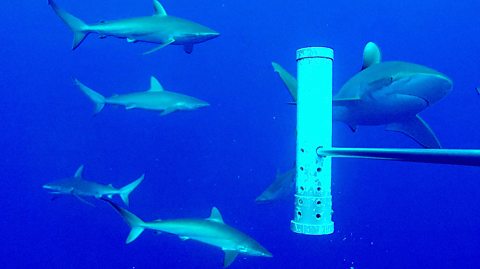
#Underwater mountains
Seamounts and Sharks
Под вълните, океанските течения реват като вятър над върховете на . Тези сеаманти се издигат рязко от морското дъно, достигайки височини от поне 1000 метра (3300 фута). Някои са осеяни с кратери, а други са осеяни с ръбове. Други са с големи плоски платота отгоре. Понякога върховете дори се прокрадват над повърхността на океана, образувайки острови. Сеамантите са граници. Тук, на ръба на дълбокия, на всеки етап от хранителната верига – от риби, които ядат планктон, до върхови хищници. Всеки сеамант е уникален и кипи от живот. Те са претъпкани с и много други. В сравнение с равни морски дъна, сеамантите приютяват по-голям брой и разнообразие от същества, много от които не се намират никъде другаде в света. И вероятно има много други. Смята се, че има повече от 100 000 подводни планини – от замразените води на до . но не са били проучени. „Необикновено голям брой вулканични сеаманти са открити на морското дъно през последните две десетилетия“, казва Али Машаек, асоцииран професор по климатични динамики в Университета в Кеймбридж, Великобритания. И днес, като , сеамантите се откриват. По време на скорошна експедиция за изследване на сеаманти в Атлантическия океан, учените откриха необичаен брой от върховите хищници на океана – акули. „Беше като да живееш в малко село насред никъде“, казва Сам Уебър, който работи на остров Ascension в продължение на седем години като негов главен консултант по опазване. „Вие знаете всички. Не са много неща, които да правите, но има хубави плажове, хубаво гмуркане, хубаво ходене.“ Ascension Island е „“ на косъм между Африка и Бразилия, само малка точка на земя в тропическия североизточен Атлантик. Но ако погледнете под вълните на сякаш безкрайния океан, обграждащ острова, ще откриете различна история. Ascension е връх на подводна вулкана, която „„ и се е превърнала в остров“, казва Уебър. Това е само един от веригата сеаманти, простираща се на стотици мили, „„ и на юг, през Хелена и цяла Африка – през Атлантическия океан. Уебър, сега професор по морска херматропна екология и опазване в Университета в Ексетър, Великобритания, е проучил приблизително 300 км (186 мили) от брега на Ascension Island. Върхът на сеамант Харис Стьюарт е дълбок, достигайки само височината на , глобалния слой на океана, който се намира между „светлината“ и „нощта“. На около 200 до 1000 метра (650 до 3300 фута) зоната на залез слънце е осветена от вечно приглушено сиво. Сестрата „Южни сеаманти“ на Гратън и Юнг, от друга страна, са относително плитки. Тези върхове се издигат на височина 80 км (50 мили) между двата сеаманта. Silky sharks, yellowfin tuna, and bigeye tuna travelled hundreds of kilometres from seamount summits but seemed to remain "site-attached", says Weber. Acoustically tagged Galapagos and silky sharks were also seen to travel the 80km (50 miles) between the two Southern Seamounts, as if they considered both the two summits home. Meanwhile, silky sharks moved off the seamount summits at night only to return at dawn – indicating the "halo" of enhanced predator abundance expands and contracts in unison with night and day. "So, it's a zone of enrichment, and they connect to each other. When you're thinking about protected area design, you need to be thinking bigger than just the summit itself," says Weber. Evidence is mounting that shows seamounts are irreplaceable oases of biodiversity in the deep ocean and of vital importance to elasmobranchs – which include sharks, rays and skates – on the planet. "Sharks are a crucial part of the entire marine ecosystem, from shallow to deep, from coastal to offshore," says Koehler. "With over a thousand species, you can imagine each of those single species has their own role to play." But gathering together in one place is risky. , seamounts – where desirable fish can readily be found – have been subject to bottom trawling by industrial fisheries. "The biggest threat to sharks is overfishing," says Koehler. "That includes commercially targeted fishing, but also bycatch. This is where they don't intentionally go for sharks – but due to the gear they use and the places they go, they do catch a lot of sharks. And they land them, and market them." Bycatch is one of the five biggest threats to life in the ocean, and . how many sharks are killed by commercial fisheries every year but the number is thought to be in the . Bottom trawling is a particularly destructive method of fishing, says Koehler. "A heavy net, that's weighed down, is dragged across the seafloor," she explains. "You can imagine how much damage that does to the fine sponges, the corals, all those really fragile ecosystems. You basically remove them. And what you've got left is just a bare field of nothing." Everything in the fishers' path is scraped up from the ocean floor, not just the target species but any species that happens to be there. "Bottom trawling demolishes the benthic ecosystem. The whole food web – decimated,” adds Weber, “And a lot of these species that live on seamounts are very slow-growing. They have very slow life histories. Then these boom-bust fisheries turn up and go, 'Whoa, there's loads of fish'. They scoop them all up, and they're gone." The impact of bottom trawling on seamounts can , adds Koehler. "It will take more than a human's lifetime – more than multiple lifetimes – for these ecosystems to regenerate and to recover. And in the meantime, you remove these really important services: food sources, nursery grounds. They are not functional anymore for those species that really depend on them." However, is also vital knowledge for advancing conservation. In 2024, Emanuel Gonçalves, chief scientist at the Oceano Azul Foundation led an Western Europe's tallest – albeit underwater – mountain, off the coast of Portugal. The following year Portugal’s government announced the . "Seamounts rise thousands of meters from the abyssal plains and attract or are home to a myriad of ocean life," says Gonçalves. "Deepwater corals and sponges can live for thousands of years on their slopes. Deepwater fish and invertebrates, whales, sharks and tuna – and many [species] still undescribed to science. Seamounts are unique and need to be protected. " In the Ascension Islands, too, the (EEZ) was in 2019. In 2021, the United Nation's stated, "Fishing, especially bottom trawling, constitutes the greatest current threat to seamount ecosystems." And, in October 2025, the International Union for Conservation of Nature's " " was adopted – calling for a global transition away from bottom trawling on seamounts by the end of 2026. However, Weber says, preventing bottom trawling alone is not sufficient as top predators are often caught by pelagic longlines too.
0 коментара
Остави коментар


Scroll to Top